Stoic Virtues for Addiction Recovery: Wisdom & 12-Step Principles
Welcome to the first article in a two-part series covering the four Stoic virtues. Stoicism is an ancient philosophy that centers on living a virtuous life, and the key to living is to live according to four virtues. This article will explore the four virtues, what it means to practice them, and how we can utilize them to enhance our recovery.
Pursuing the Stoic virtues while in recovery guides us to being the person we wish to be. The Stoics believed that living a virtuous life was essential to experiencing peace and fulfillment. They focused on four virtues: courage, justice, wisdom, and temperance, which will be the focus of this article.
As I hope you can see throughout my articles, I never suggest Stoicism above or as a replacement for the practices found in AA or other 12-step programs. After decades of working the 12 steps, I have found it comforting to find another body of wisdom that I can study to solidify and further improve the quality of my sobriety.
Throughout my journey, marked by a series of struggles and triumphs, pursuing stoic virtues has served as a shining beacon of hope and resilience. We confront many formidable challenges in overcoming substance abuse and behavioral addictions. Accordingly, a box full of “tools for a better life” has been vital for me to draw upon.
What is Stoicism? An Introduction for Recovery
Stoicism was established by Zeno of Ctium around 300 B.C. Its roots are in preceding philosophies, such as Socratic, Cynicism, and Heracliten—stoicism advocates for a life in harmony with nature and guided by reason.
Stoicism is often referred to as the art of living because it teaches practical wisdom for navigating life’s challenges with virtue and resilience. At its core is the development of wisdom, courage, justice, and temperance. We live a virtuous life when our actions are based on these virtues rather than being swayed by external circumstances beyond our control.
As a renowned Stoic philosopher, Marcus Aurelius, once stated, “You have power over your mind—not outside events. Realize this, and you will find strength.” I love this quote, and it has become a mantra for me. The Stoics’ prime focus was paying attention to what they could control in life. We can only control our thoughts and actions, and practicing virtue guides us in the right thoughts and actions.
Understanding Addiction and the Path to Recovery
Understanding the causes, symptoms, and characteristics of addiction is complex and continues to evolve today. The simplest definition is when one uses a substance to accept a reality they do not believe they can otherwise. The use of these substances progresses to where one cannot control their use, and they start to experience unacceptable negative consequences like losing jobs, family, friends, and good health.
When the realization of the destruction hits, they become convinced that the behavior must stop but find themselves unable to do so. Until they see and work a 12-step program or other effective addiction treatment, life will continue to worsen for the person with an addiction and often end in death.
Regardless of the path to sobriety, studying Stoicism offers a path toward liberation and self-control when we choose to overcome our addiction. The study matches well with 12-step programs as there are many parallels in thinking and goals. Epictetus, a Stoic philosopher, aptly noted, “We cannot choose our external circumstances, but we can always choose how we respond to them.”
Addiction is a progressive disease and not something that we are willing to sign up for, and as such, it would be considered an external circumstance. We can respond to it by remaining in the grips of the disease or seeking help to escape.
Exploring the Four Stoic Virtues: Wisdom, Courage, Justice, Temperance
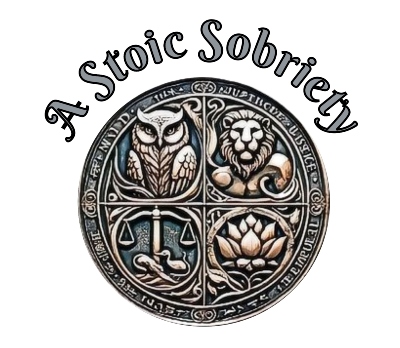
The four Stoic virtues — wisdom, courage, justice, and temperance — form the foundation of Stoic ethics and guide how to live a good, meaningful life. These virtues originate from ancient Greek philosophy, particularly from Plato, but were fully developed by Zeno of Citium, the founder of Stoicism, and later emphasized by Stoics such as Seneca, Epictetus, and Marcus Aurelius.
For the Stoics, practicing these virtues led to eudaimonia—a flourishing and tranquil life. They believed virtue is the only true good, and external things (wealth, health, status) are “indifferent”—not essential for happiness. Together, these four virtues help align our lives with nature and reason, which is the Stoic goal.
Let’s delve deeper into each of the four virtues to understand better their meaning, how they align with AA’s beliefs, and how we can apply them.
Stoic Wisdom: Discerning Right from Wrong in Recovery
Knowledge is often confused with wisdom, so a good starting point is to understand the difference. We gain knowledge by attending school, reading books, or engaging in conversations with others. It consists of facts, data, and information. Wisdom is the application of knowledge; it is what we do with our understanding.
For example, we may have learned from others or experienced ourselves that when the stove is on, it is hot and will burn us if we touch it. That is knowledge, whereas wisdom is putting that information into action by not touching the stove while it is on and keeping ourselves safe from harm.
Stoic wisdom is about discerning right from wrong, understanding what is within our control and what isn’t, and making informed decisions based on that knowledge. Think of it like being a ship captain who knows how to navigate stormy seas safely because they understand the sea, the weather, and the ship well. They decide on the best course of action by applying their knowledge to the situation. Knowledge without action cannot become wisdom.
Developing wisdom requires a significant understanding of the virtues and sustained trial and error. This is why the wise are usually in the mid-to-late stages of life, as wisdom is not developed overnight. Some philosophies say one can lead a fulfilling life with knowledge alone, but the Stoics disagree. The art of living consists of possessing excellent expertise, but it also requires application and practice to be truly meaningful.
Wisdom in 12-Step Programs: The Serenity Prayer and Shared Experience
In 12-step programs, seeking this wisdom is summed up in The Serenity Prayer. The prayer, “God, grant me the serenity to accept the things I cannot change, the courage to change the things I can, and the wisdom to know the difference,” not only asks for wisdom in our thinking but also for the courage to act when necessary. When we align our subsequent actions to the four virtues, we practice Stoicism.
Additionally, as a fellowship, we have shared experience with over 89 years of wisdom at the time of this writing. Not only is this available in many print forms, but it can be sought out and experienced in over 69,000 AA meetings (2020 estimate) in the US alone. How do we know this is wisdom instead of knowledge?
The approach was trial and error from the beginning of AA, lasting four years, until the publication of the Big Book. The formula was simple: Keep what works for the majority and discard the rest. Try different things and see what works, gain knowledge, and then put that information to work by integrating it into a workable program for recovery. The fellowship has gained considerable wisdom through the actions of the founders, early AAs, and the many who have made the program work for them.
When we attend meetings, read our Big Book, or converse with others about our disease, we gain knowledge from others’ experiences. When faced with similar situations or challenges, we can draw from that knowledge when taking action to address the challenges in our lives. We begin to develop wisdom when we apply our information and see the results for ourselves.
Twelve-step programs are action-oriented. We do not think our way out of addiction; we act by not taking that first drink, cleaning up or past it, and passing on our experiences. We also have much knowledge if we seek it (more action). Naturally, this creates an environment for us to develop wisdom over time.
Practical Steps to Cultivate Wisdom for Lasting Sobriety
1) Continual Learning: The knowledge we need to develop wisdom doesn’t just come from books. If we keep an open mind and pay attention to what is happening around us, life offers limitless knowledge. We live in a time where data and information are literally at our fingertips for the asking. We are. It comes from real life. Please pay attention to your experiences and learn from them.
2) Asking Important Questions: We must ask questions to learn effectively. We can be passive and absorb information as it passes by, but we do not always gain a complete understanding of what we are learning without questioning and confirming that what we have heard or read makes sense in our minds.
3) Taking action: Knowledge transforms into wisdom through action. We need to apply what we learn in real life. We often go through a trial-and-error process, using our information in different ways and scenarios to determine the right thoughts and actions that best represent our character. We may also need to use trial and error when presented with contradictory information and must decide what is most accurate.
Dieting is a good example, as we are presented with various diets, all proclaiming to be the best for us. Without trying each diet and noting its effectiveness, we will never have developed the wisdom to know what diet is proper for us. Seneca said, “True wisdom is to know what is best worth knowing and to do what is best worth doing.” By acting on it, people develop real wisdom that helps them stay sober and live meaningful lives.
Conclusion
Practicing the Stoic virtues goes hand-in-hand with our recovery goal of becoming better. We focus on wisdom, courage, justice, and temperance to respond to life’s challenges. Like our work in 12-step programs, we are reminded to focus on what is within our control and let go of what is not. As we grow in wisdom and apply what we’ve learned through experience, we become stronger and more capable of handling whatever comes our way.
In the second article, we will cover the remaining virtues: courage, justice, and temperance. We will see how practicing all four leads to a virtuous and meaningful life.
Resources
Internet Encyclopedia of Philosophy – Stoic Ethics (virtues)
Donald Robertson – Modern Day Stoic

Written By Tony Harte
Blog Articles